Trade-Offs Between Ranking Objectives: Descriptive Evidence and Structural Estimation
Abstract
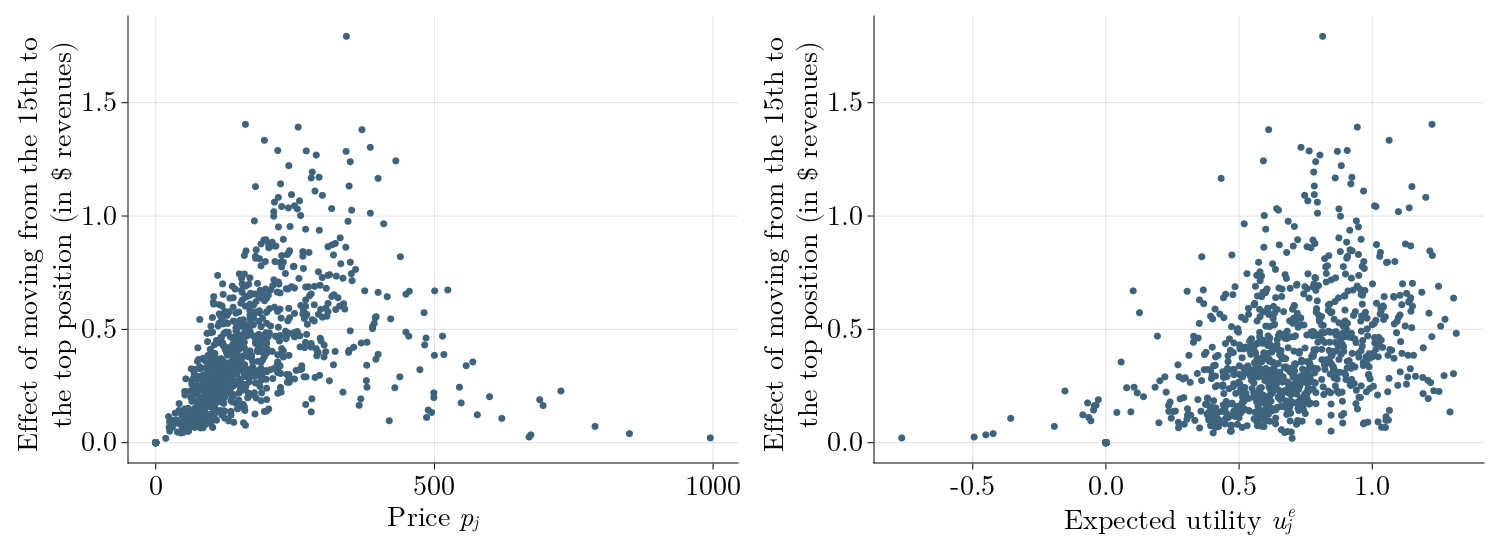
When designing product rankings, online retailers and platforms choose which outcome to maximize: revenues from commissions or markups, the number of transactions, or consumer welfare. These objectives need not align, creating potential trade-offs. This paper studies how rankings differ between objectives and quantifies the resulting trade-offs. I provide descriptive evidence showing that lower-priced and high-utility alternatives gain more demand when ranked higher, suggesting that ranking them higher increases transactions and consumer welfare but may decrease revenues. To quantify these trade-offs, I develop and estimate a structural demand model based on the search and discovery framework of Greminger (2022) and construct rankings for each objective. The results show that these counterfactual rankings all increase consumer welfare, transactions, and platform revenues relative to a neutral benchmark and the status quo, and that trade-offs between these rankings are limited.